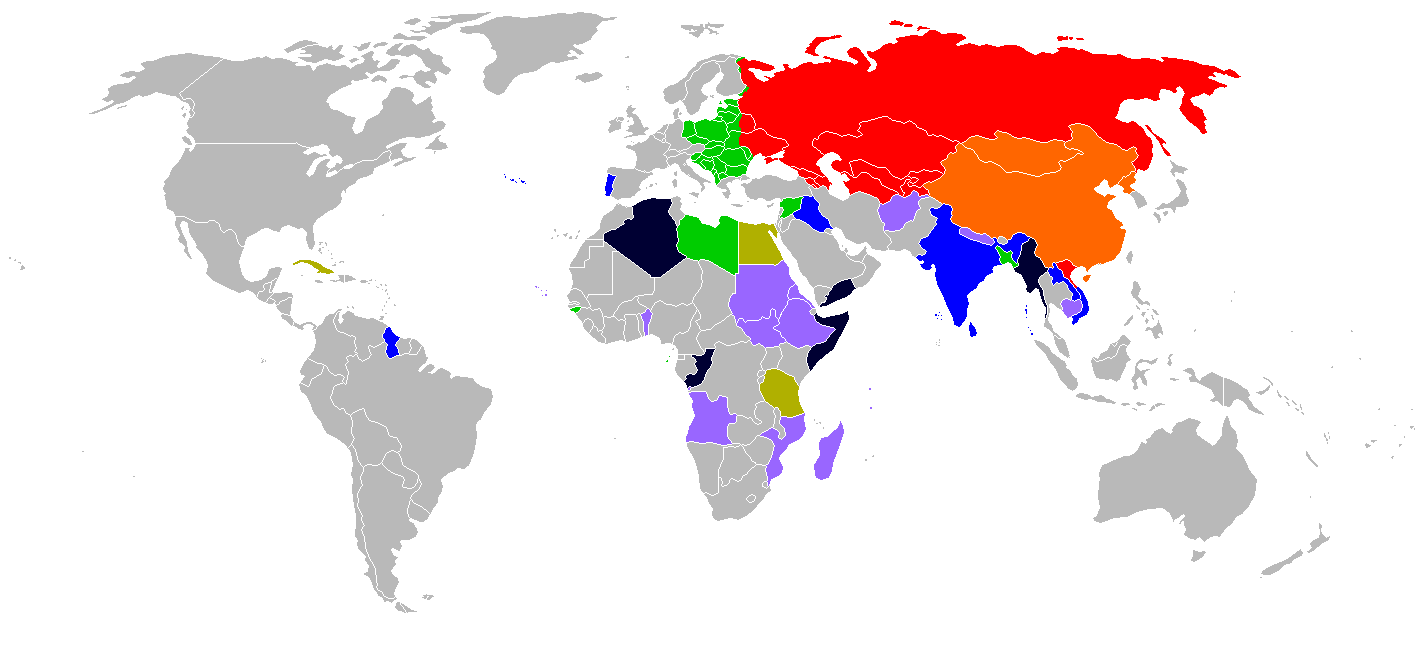
Several past and present states have declared themselves socialist states or in the process of building socialism. The majority of self-declared socialist countries have been Marxist–Leninist or inspired by it, following the model of the Soviet Union or some form of people's or national democracy. They share a common definition of socialism, and they refer to themselves as socialist states on the road to communism with a leading vanguard party structure, hence they are often called communist states. Meanwhile, the countries in the non-Marxist–Leninist category represent a wide variety of different interpretations of the term socialism, and in many cases the countries do not define what they mean by it. Modern uses of the term socialism are wide in meaning and interpretation.
Because a sovereign state is a different entity from the political party that governs that state at any given time, a country may be ruled by a socialist party without the country itself claiming to be socialist or the socialist party being written into the constitution. This has occurred in both one-party and multi-party political systems. In particular, there are numerous cases of social democratic and democratic socialist parties winning elections in liberal democratic states and ruling for a number of terms until a different party wins the elections. While socialist parties have won many elections around the world and most elections in the Nordic countries, none of those countries have adopted socialism as a state ideology or written the party into the constitution.
Several countries with liberal democratic constitutions mention socialism. India is a democracy that has been governed by non-socialist parties on many occasions, but its constitution makes references to socialism. Certain other countries, such as Hungary, Myanmar, and Poland have constitutions that make references to their communist and socialist past by recognizing or condemning it, but without claiming to be socialist in the present.
Overview
Self-identification is the only criterion used by the list, therefore it includes all countries that have claimed to be socialist, even if their claims are disputed. All countries that have not claimed to be socialist are excluded, even in cases where certain outside observers regarded those countries as socialist. Mao Zedong and the Communist Party of China considered the Taiping Heavenly Kingdom to be a proto-communist state, although the kingdom never declared itself socialist, hence it is not included on this list. The list includes countries that assert in their constitutions that they are based on socialism, regardless of their economic or political system. It does not list countries that do not have constitutional references to socialism as socialist states, even in cases where the government is currently run by a socialist party or other left-wing (centre-left and far-left) parties. Countries that maintain constitutional references to socialism are listed, even when non-socialist parties govern those countries. The list is best understood as a list of countries that explicitly claim to be socialist, and it does not reflect the actual economic systems themselves.
Current self-declared socialist states
Communist states
Other states
Socialist autonomous regions
These are territories that have claimed autonomy and declared themselves as socialist under some interpretation of the term. While these regions have created stable institutions of governance that have existed for a considerable period of time, they are not widely recognized as autonomous by the international community and officially are parts of other sovereign states under international law.
Former self-declared socialist states
Marxist–Leninist states
Non-Marxist–Leninist states
Ephemeral socialist states and polities
These are short-lived political entities that emerged during wars, revolutions, or unrest and declared themselves socialist under some interpretation of the term, but which did not survive long enough to create a stable government or achieve international recognition.
- Lyon Commune (4 September 1870 – 28 September 1870; 22 March 1871 – 25 March 1871)
- Paris Commune (18 March 1871 – 28 May 1871)
- Committee of Public Health (8 July 1873 – 13 July 1873)
- Republic of Guria (May 1902 – 10 January 1906)
- Strandzha Commune (18 August 1903 – 8 September 1903)
- Markovo Republic (31 October 1905 – 18 July 1906)
- Stary Buyan Republic (12 November 1905 – 26 November 1905)
- Chita Republic (22 November 1905 – 22 January 1906)
- Novorossiysk Republic (12 December 1905 – 25 December 1905)
- Shuliavka Republic (12 December 1905 – 16 December 1906)
- Comrat Republic (6 January 1906 – 12 January 1906)
- Ukrainian People's Republic (1917–1921)
- Harbin Soviet (September 1917 – December 1918)
- Executive Committee of the Soviet of Workers, Soldiers, and the Landless in Latvia (21 November 1917 – 3 March 1918)
- Crimean People's Republic (1917–1918)
- Soviet Republic of Soldiers and Fortress-Builders of Naissaar (December 1917 – February 1918)
- Belarusian People's Republic (1918–1919)
- West Ukrainian People's Republic (1918–1919)
- Finnish Socialist Workers' Republic (28 January 1918 – 29 April 1918)
- Odessa Soviet Republic (31 January 1918 – 13 March 1918)
- Donetsk–Krivoy Rog Soviet Republic (12 February 1918 – May 1918)
- Baku Commune (13 April 1918 – 25 July 1918)
- Transcaucasian Democratic Federative Republic (22 April 1918 – 28 May 1918)
- Democratic Republic of Georgia (May 1918 – February 1921)
- Constitution Protection Region of Southern Fujian (1 September 1918 – 12 August 1920)
- Banat Republic (31 October 1918 – 20 February 1919)
- Republic of Tarnobrzeg (6 November 1918 – Spring 1919)
- People's State of Bavaria (8 November 1918 – 6 April 1919)
- Free Socialist Republic of Germany (9 November 1918 – 11 August 1919)
- Mainz Workers' and Soldiers' Council (9 November 1918 – 9 December 1918)
- Alsace-Lorraine Soviet Republic (10 November 1918 – 22 November 1918)
- Brussels Soldiers' Council (11-12 November 1918)
- Soviet Republic of Saxony (13 November 1918 – 11 May 1919)
- Commune of the Working People of Estonia (29 November 1918 – 5 June 1919)
- Latvian Socialist Soviet Republic (17 December 1918 – 13 January 1920)
- Hungarian People's Republic (16 November 1918 – 21 March 1919)
- Makhnovshchina (27 November 1918 – 28 August 1921)
- Würzburg Soviet Republic (7 April 1919 – 9 April 1919)
- Bremen Soviet Republic (10 January 1919 – 4 February 1919)
- Lithuanian–Byelorussian Soviet Socialist Republic (27 February 1919 – 25 August 1919)
- Republic of Councils in Hungary (21 March 1919 – 6 August 1919)
- Mughan Soviet Republic (March 1919 – June 1919)
- Bavarian Soviet Republic (6 April 1919 – 3 May 1919)
- Limerick Soviet (14 April 1919 – 17 April 1919)
- Crimean Socialist Soviet Republic (28 April 1919 – 26 June 1919)
- Bessarabian Soviet Socialist Republic (May 1919 – September 1919; 15 September 1924 – 18 September 1924)
- Slovak Soviet Republic (16 June 1919 – 7 July 1919)
- Far Eastern Republic (6 April 1920 – 15 November 1922)
- Provisional People's Government of Mongolia (1921–1924)
- Persian Socialist Soviet Republic (9 June 1920 – September 1921)
- Galician Soviet Socialist Republic (8 July 1920 – 21 September 1920)
- Provisional Polish Revolutionary Committee (23 July 1920 – Late August 1920)
- Labin Republic (2 March 1921 – 8 April 1921)
- Serbian–Hungarian Baranya–Baja Republic (14 August 1921 – 20 August 1921)
- Soviet Zone (1927–1937)
- Hunan Soviet (September 1927 – October 1927)
- Guangzhou Soviet Government (12 December 1927 – 13 December 1927)
- Central Revolutionary Base Area (1931–1934)
- Korean People's Association in Manchuria (1929–1931)
- Nghệ-Tĩnh Soviet (1930–1931)
- Chinese Soviet Republic (7 November 1931 – 22 September 1937)
- Socialist Republic of Chile (4 June 1932 – 2 October 1932)
- People's Revolutionary Government of the Republic of China (22 November 1933 – 13 January 1934)
- Xinjiang Clique (1934–1941)
- Asturian Commune (October 1934)
- Regional Defence Council of Aragon (1936–1937)
- Revolutionary Catalonia (1936–1939)
- Sovereign Council of Asturias and León (6 September 1936 – 21 October 1937)
- Shaan-Gan-Ning Border Region (1937–1946)
- Finnish Democratic Republic (December 1939 – March 1940)
- Republic of Užice (28 July 1941 – 1 December 1941)
- Bihać Republic (4 November 1942 – 29 January 1943)
- Political Committee of National Liberation (10 March 1944 – 9 October 1944)
- East Turkestan Republic (12 November 1944 – 27 June 1946)
- Red Republic of Caulonia (6 March 1945 – 9 March 1945)
- Inner Mongolian People's Republic (9 September 1945 – 6 November 1945)
- People's Republic of Korea (1945–1946)
- Soviet Civil Administration (1945–1949)
- Liberated Zone (1946–1949)
- Azerbaijan People's Government (November 1945 – December 1946)
- Republic of Mahabad (22 January 1946 – 15 December 1946)
- Provisional People's Committee for North Korea (1946–1947)
- People's Committee of North Korea (1947–1948)
- Provisional Democratic Government (1947–1949)
- Marquetalia Republic (1948–1964)
- Government of the National Front of the Region of Madiun (18 September 1948 – 19 December 1948)
- People's Republic of Zanzibar (1964)
- Republic of South Vietnam (8 June 1969 – 2 June 1976)
- State of the Comoros (3 August 1975–13 May 1978)
- People's Provisional Government (1977–1979)
- Junta of National Reconstruction (18 July 1979 – 10 January 1985)
- Democratic People's Republic of Angola (1979–1992)
- National Revolutionary Council (30 July 1981 – 5 August 1981)
- Coalition Government of Democratic Kampuchea (22 June 1982 – 24 September 1993)
- National Council for the Revolution (1984–1987)
- Republic of Kuwait (4 August 1990 – 28 August 1990)
- Democratic Republic of Yemen (21 May 1994 – 7 July 1994)
- Provisional Government of National Union and National Salvation of Cambodia (11 July 1994 – 22 June 1998)
- Capitol Hill Autonomous Zone (8 June 2020 – 1 July 2020)
See also
- List of anarchist communities
- Communist state
- Second World
- People's republic
- Socialism in one country
- Socialist-leaning countries
- State socialism
Notes
References